4/15/2026
Are Your AI Initiatives Just Burning Budget? The Blueprint for Real ROI.
Uncontrolled AI adoption creates chaos, not profit. Leverage existing systems with a 'No New Software' blueprint to guarantee measurable ROI and decouple growth from headcount.
Let's be blunt: most companies diving into AI are setting their budget on fire. They're treating powerful generative AI tools like a magic search engine, throwing generic prompts at complex business problems and expecting a turnkey solution. What they get instead is a tangle of unvalidated experiments, operational drag, and a P&L drain—all without moving the needle on revenue or efficiency.
Why do most AI initiatives burn budget instead of generating ROI?
The stark reality is, AI doesn't understand your business context implicitly. It's not a mind-reader. Just like a new hire needs an onboarding manual, a product spec, and access permissions, AI needs a precise blueprint of your existing operations, data, and desired outcomes. Without this foundational understanding, AI's output is generic, inconsistent, and often introduces more complexity than it solves, leading to significant project churn and wasted spend.
Ignoring the need for a detailed strategic blueprint means you're gambling with precious department budgets. This ad-hoc approach inevitably leads to custom, one-off solutions that create new silos, introduce unforeseen security risks, and demand continuous, costly human intervention to "fix" AI's misinterpretations. This is precisely how you scale chaos, not revenue, and inflate headcount requirements for simple automations.
What does a "blueprint" for AI integration look like?
My "No New Software" mandate means we don't build custom apps; we orchestrate existing ones. The blueprint isn't for a new product; it's a meticulously documented strategy for how AI interacts with and enhances your current tech stack. This systematic approach ensures AI delivers measurable value by optimizing existing workflows, reducing operational expenditure, and unlocking new revenue streams without the burden of developing proprietary software.
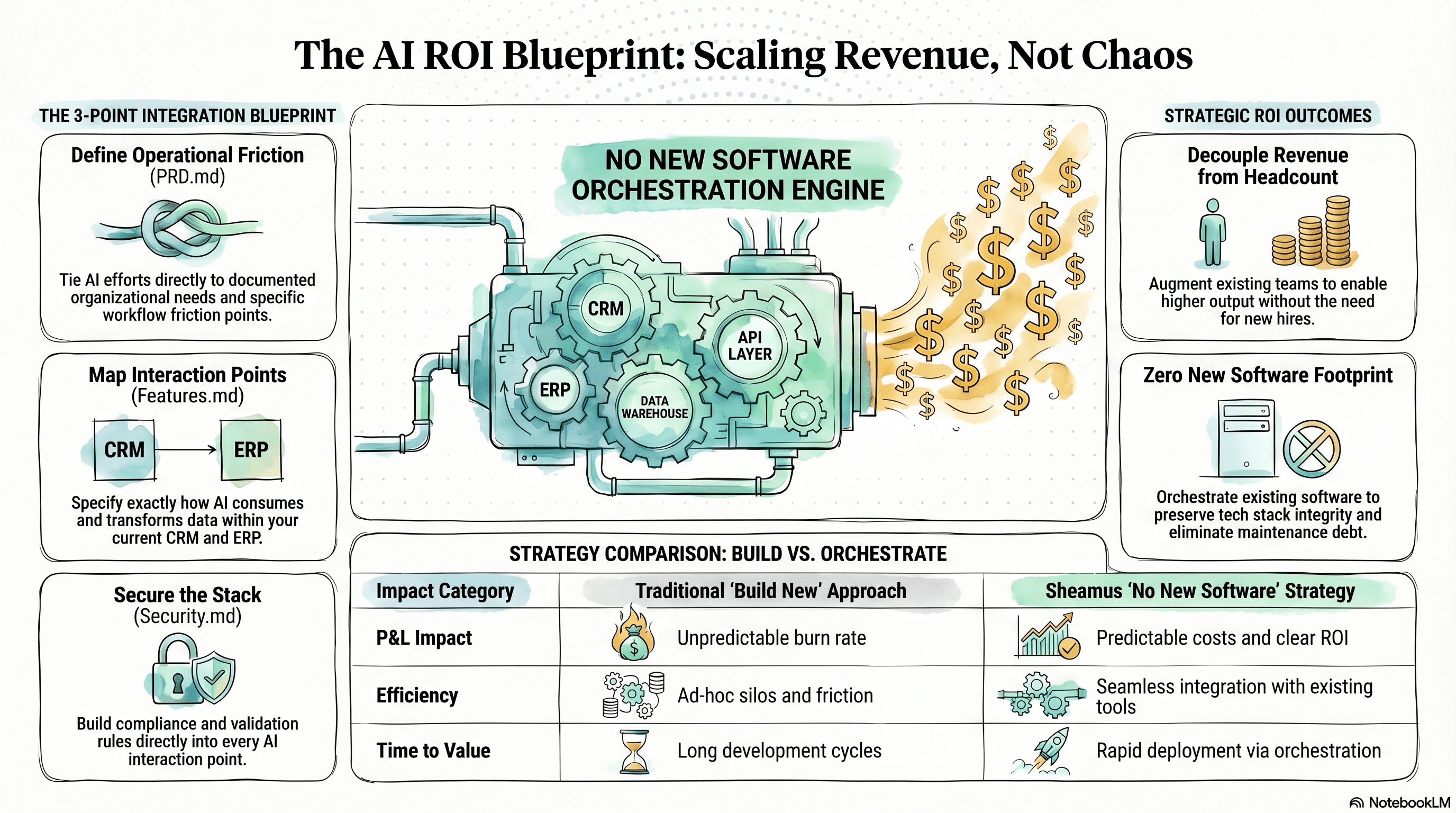
This blueprint consists of several core "documents," reframed for strategic AI integration:
-
Business Problem & Process Flow (e.g., PRD.md): Defines the exact operational friction points AI will alleviate within your existing processes. It answers: What specific business problem does AI solve? Which current workflow steps are being augmented or automated? This ensures AI efforts are directly tied to an organizational need, not just tech for tech's sake.
-
AI Interaction Points (e.g., Features.md): Details precisely how AI will consume, transform, and output data within your existing tools (CRM, ERP, marketing platforms, etc.). It specifies inputs, expected outputs, and the exact business logic AI must follow. This pre-defines AI's operational scope, preventing feature creep and costly re-work.
-
Existing Data Context (e.g., Database.md): Maps out the existing data structures AI will interact with, whether reading from a data warehouse or updating fields in your CRM. This isn't about creating new schemas, but about providing AI with an unambiguous understanding of your current data landscape, ensuring data integrity and relevance.
-
Existing System Interfaces (e.g., API.md): Lists the specific API endpoints of your current software AI will connect to. This dictates how AI integrates, ensuring it leverages your existing technology investments without requiring new middleware or custom code that adds to your technical debt.
-
Existing Stack Integration (e.g., Architecture.md): Outlines how new AI services (e.g., specific LLM APIs, data analytics engines) will plug into your current infrastructure. It clarifies infrastructure dependencies and ensures seamless integration, avoiding compatibility issues and ensuring AI initiatives fit within your established environment.
-
Compliance & Control (e.g., Security.md): This crucial document defines how AI accesses, processes, and stores sensitive data within your existing systems. It specifies validation rules, authentication methods, data anonymization requirements, and retention policies, ensuring strict adherence to compliance and data governance standards.
How does this strategy prevent "new software" bloat and protect your P&L?
By building out this comprehensive blueprint, you shift from reactive, costly AI experiments to predictable, high-ROI automation. My approach leverages your existing infrastructure, maximizing the value of past investments and minimizing the need for new development. It's about surgical precision in AI deployment, not broad-spectrum code deployment.
| Feature | Traditional "Build New" Approach (without Blueprint) | Sheamus "No New Software" Strategy (with Blueprint) |
|---|---|---|
| P&L Impact | Unpredictable project costs, high burn rate, limited ROI, potential for negative impact on existing operations. | Predictable costs, clear ROI metrics, leverages existing spend, direct positive impact on operational margins. |
| Operational Efficiency | Ad-hoc integrations create new silos, increase manual oversight, introduce operational friction. | Seamless integration with existing tools, reduces manual tasks, eliminates operational drag, scales output per FTE. |
| Headcount Management | Requires new developers, AI engineers, or analysts to manage custom code and ad-hoc solutions. | Augments existing teams, optimizes current headcount, enables higher output without new hires, frees up resources. |
| Software Footprint | Adds custom applications, new tech stacks, and significant technical debt to maintain. | Connects and orchestrates existing software, zero new custom software, preserves existing tech stack integrity. |
| Risk & Compliance | Unforeseen security vulnerabilities, data privacy breaches, compliance gaps due to lack of upfront planning. | Proactive security integration, documented data governance, compliance built into every AI interaction point. |
| Time to Value | Long development cycles, extensive testing, slow deployment, delayed or unrealized ROI. | Rapid deployment by orchestrating existing capabilities, quicker validation, accelerated time to measurable value. |
Who is this structured AI integration strategy NOT for?
This strategic approach is highly effective for leaders focused on measurable business outcomes, but it's crucial to understand its scope. This solution is NOT for organizations seeking to build entirely new, proprietary AI models from scratch, as that falls outside the "No New Software" mandate. It's also not for those who view AI as a magic bullet to throw at vague problems without a clear, documented understanding of their existing processes or data. Furthermore, it's not for companies unwilling to invest the initial effort in thoroughly documenting their current systems, APIs, and desired business outcomes.
My value is in orchestrating existing resources, not in inventing new ones. If you're chasing the next shiny object without a clear, documented path to ROI, my strategy isn't for you. If you're ready to meticulously define your operational challenges and leverage AI to scale revenue, not chaos, using what you already have, then we should talk.
Ready to implement AI strategically to scale revenue, not chaos, and protect your P&L? Let's connect and build your AI integration blueprint.