4/13/2026
Is Your Procurement Strategy Ready for the 2026 Profit Gauntlet?
The next wave of AI isn't about buying new software; it's about strategically orchestrating existing tools to eliminate operational drag in procurement. This delivers immediate P&L impact, decoupling output from headcount without adding chaos.
Why is "speed" the new budget line item in procurement?
The old rhythm of procurement, balancing cost and resilience, has been shattered. Geopolitical shifts, fragmented supply chains, and rapid digital evolution mean decision cycles are brutally compressed. Every delayed decision, every manual bottleneck, directly erodes your margins and ties up critical working capital. This isn't just about market volatility; it's about operational velocity impacting your P&L today.
What truly defines a forward-thinking procurement leader in 2026?
It’s not about how many AI gadgets you've piloted. The real test of leadership is the willingness to challenge outdated processes, automate the repeatable, and free up your high-value talent for judgment-intensive tasks. AI isn’t a bolt-on efficiency tool; it’s a catalyst for structural change. The goal isn't faster execution of the same work, but a strategic re-evaluation of what work truly generates value.
How do we leverage AI for structural change without adding more software or headcount?
My core mandate is "Scale Revenue, Not Chaos," with a strict "No New Software" rule. This means leveraging AI as an agnostic orchestration layer, connecting and optimizing the tools you already own. We identify operational drag, then design workflows that automatically shunt data between your existing ERP, CRM, and procurement platforms.
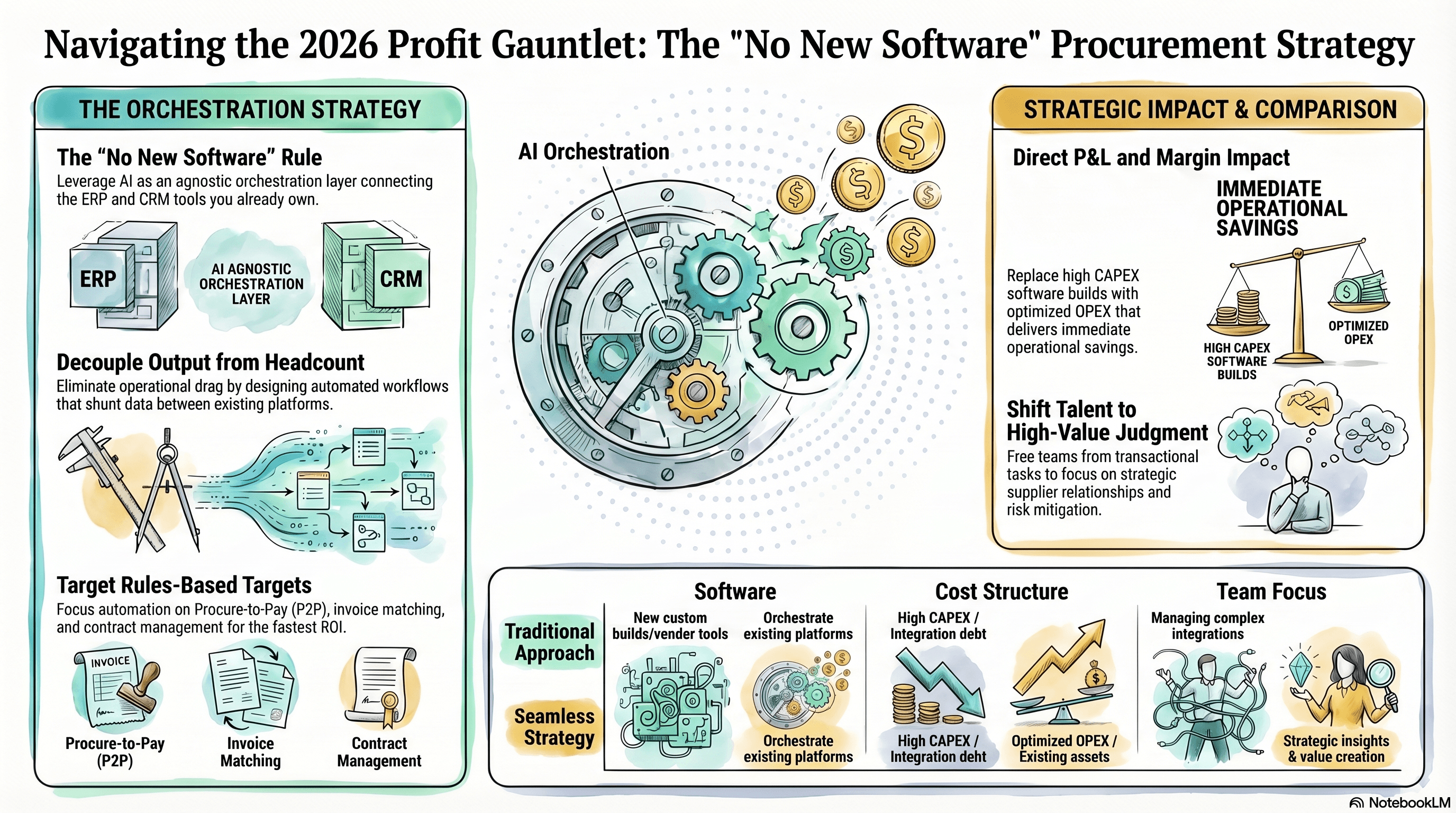
This approach eliminates redundant effort, reduces errors, and directly impacts your bottom line by decoupling output from additional headcount.
Where should we target AI automation for the fastest ROI in procurement?
Focus on the predictable. Procure-to-pay (P2P), sourcing, invoice matching, contract management, and supplier selection are prime candidates. These are rules-based, data-rich processes begging for automation. By automating these foundational elements, we create immediate capacity, allowing your team to focus on strategic supplier relationships, risk mitigation, and truly impactful trade-offs, rather than drowning in transactional tasks.
What's the biggest risk for procurement leaders failing to adopt this "orchestration first" AI strategy?
The biggest risk isn't trying AI and failing; it's getting stuck in "pilot purgatory" or investing in bespoke solutions that never scale. Organizations that don't redesign workflows around existing data foundations will struggle to generate meaningful impact. This translates to missed margin opportunities, escalating operational costs, and a competitive disadvantage as more agile players automate their way to better cost structures and faster market response times.
Who is this "No New Software" AI strategy not for?
This strategy is not for companies insistent on building proprietary, custom software from scratch, or those looking for a magic "AI button" to solve all their problems without challenging existing processes. It's also not for organizations unwilling to invest in the disciplined data hygiene necessary for AI success, or those comfortable with stagnant operational efficiency and bloated headcount-to-revenue ratios.
| Feature | Traditional Approach | Sheamus Strategy (Orchestration) |
|---|---|---|
| Software Investment | New custom builds, vendor-specific AI tools | Orchestrate existing platforms, "No New Software" |
| Implementation | Lengthy pilots, siloed projects, integration headaches | Phased orchestration of current systems, rapid rollout |
| Cost Structure | High CAPEX, ongoing license fees, integration debt | Optimized OPEX, leverage existing assets, clear ROI |
| P&L Impact | Often delayed, uncertain, hard to quantify | Direct operational savings, margin improvement |
| Team Focus | Training on new tools, managing complex integrations | Strategic insights, critical decision-making |
| Scalability | Limited by vendor lock-in, custom code dependencies | Highly scalable, flexible integration across tech stack |
If you're ready to surgically cut operational drag from your procurement processes, scale revenue, and stop the endless cycle of "new software" promises, let's talk. My fractional CTO strategy focuses on tangible, P&L-first outcomes, leveraging your existing assets to deliver immediate impact without the chaos.